
Instant payments made money movement effortless. Credit built on the same rails will need something payments never did: careful judgement.
UPI is already more than a payment rail
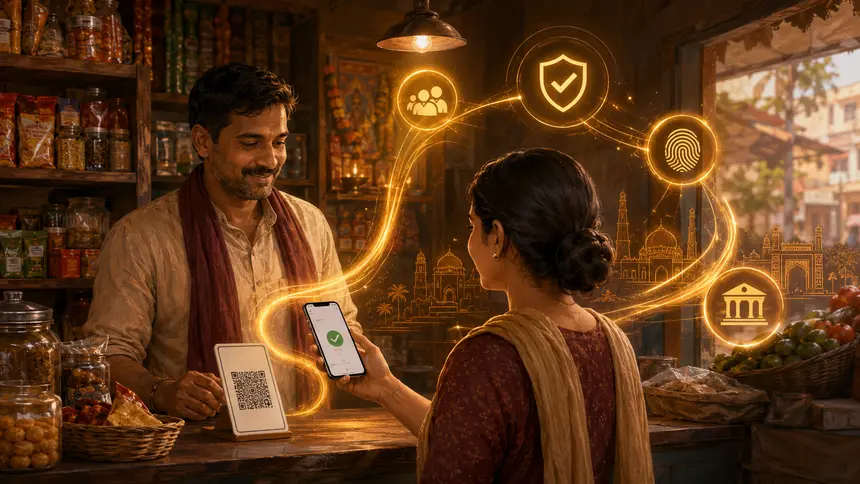
UPI began as a way to move money between bank accounts, but the network has steadily expanded. The Reserve Bank of India enabled pre-sanctioned bank credit lines to operate through UPI, and NPCI supports linking eligible RuPay credit cards to UPI for merchant payments. In other words, the same interface that made bank-to-bank payments feel immediate is becoming a distribution layer for credit too.
The scale matters. NPCI's monthly statistics show UPI handling tens of billions of transactions a month across hundreds of participating banks. When a credit feature is added to infrastructure with that kind of reach, it can change borrowing behaviour much faster than a standalone lending app ever could.
Payments and credit may look similar, but they are not the same decision
A normal UPI payment usually moves money the user already owns. Credit creates a future obligation. That difference can disappear visually when both actions happen through the same QR code, app and PIN. A frictionless interface is excellent for payments; for borrowing, some friction can actually be useful if it helps a person understand cost and repayment.
The easier credit becomes to access, the more important it becomes to make the obligation impossible to misunderstand.
This does not mean instant credit is inherently harmful. Used well, it can help a household bridge a short-term cash-flow gap or help a small business pay for inventory before revenue arrives. The danger appears when convenience hides the total cost, the due date or the fact that several small obligations are accumulating at once.
Credit on UPI needs visible boundaries
NPCI's RuPay Credit Card on UPI documentation already shows that credit use on UPI is not simply unrestricted cash. Merchant payments are allowed, while categories such as person-to-person transfers and cash withdrawal are restricted. Those boundaries are important because the product is credit, even if the interaction feels like an ordinary UPI payment.
Good design should make that distinction clearer to users too. Before borrowing, the interface should show the amount being financed, total repayment, due date, interest or fees where applicable, and what happens after a missed payment. After borrowing, the user should be able to see all outstanding obligations in one place instead of discovering them one notification at a time.
More data does not automatically mean better lending
UPI produces rich transaction histories, but payment activity should not be treated as automatic permission to lend. A high volume of transactions can mean a healthy business, but it can also reflect thin margins or unstable cash flow. A consumer who pays frequently through UPI is not necessarily asking for more debt.
The strongest credit products will therefore use data carefully. They should distinguish between a temporary liquidity need and persistent financial stress, allow users to control limits and avoid creating incentives that reward borrowing simply because a credit line is available.
The small-business opportunity is real
For small firms, embedded credit can be valuable when it connects directly to a productive need: restocking inventory, paying a supplier or covering a short receivable gap. UPI's merchant reach makes that technically easier than before. But the quality of the product will depend on underwriting and repayment design, not only on distribution.
A business owner should be able to understand why a limit was offered, how much using it will cost and what repayment will do to future cash flow. If the product cannot explain those basics in plain language, instant access is not enough.
The next chapter will be judged by outcomes
UPI proved that digital public infrastructure can change everyday behaviour at national scale. Credit riding on the same rails has similar reach but higher stakes. Success should not be measured only by how many credit accounts are linked or how quickly a loan can be used.
The better question is whether people and businesses end up with more useful financial flexibility without losing sight of what they owe. Faster credit can be a meaningful improvement. Invisible debt is not. The next chapter of UPI will be strongest when convenience and judgement grow together.