
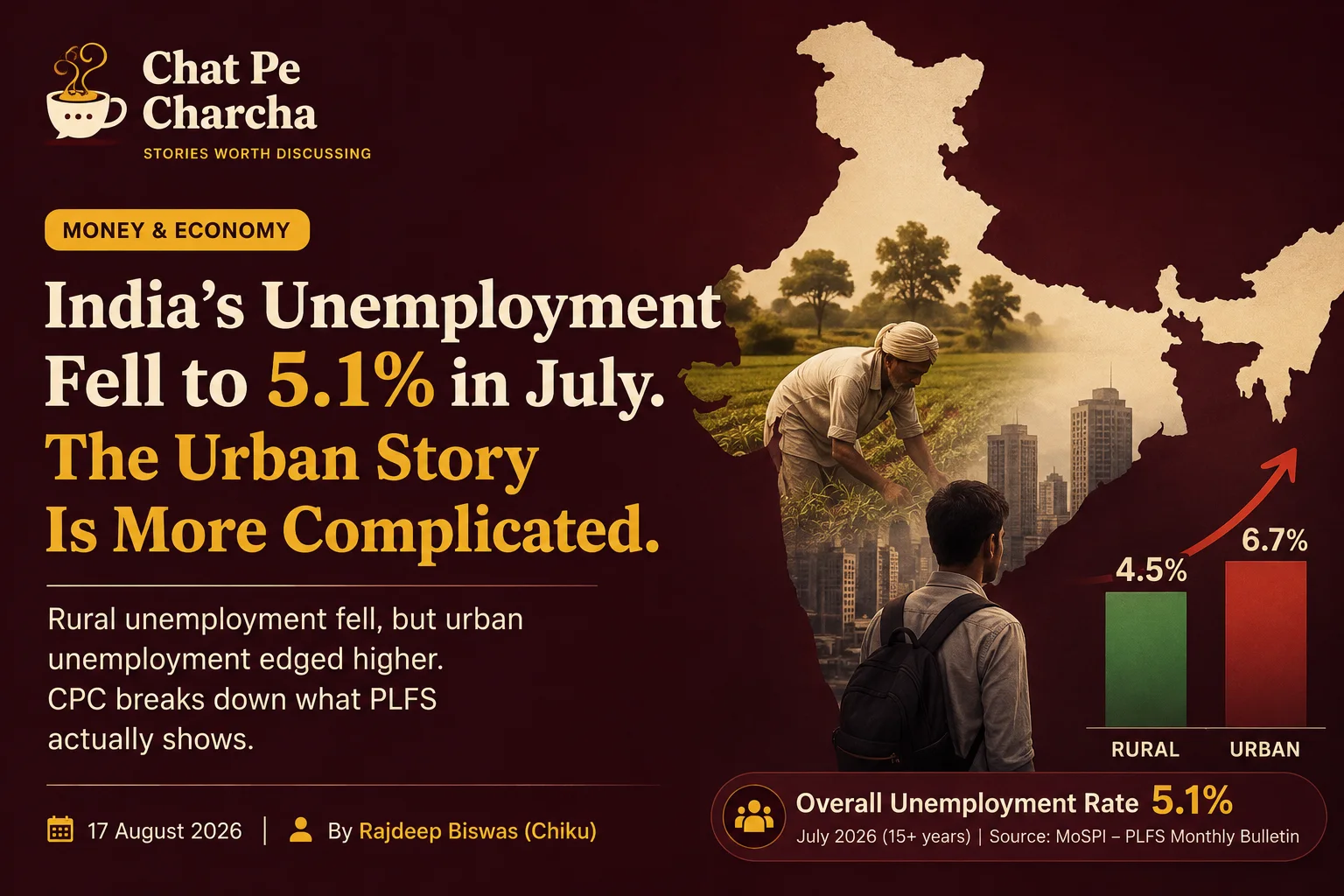

India’s July 2026 unemployment rate fell to 5.1%, but urban unemployment edged higher. CPC breaks down what PLFS actually shows.
India's headline unemployment rate improved in July 2026, but the national number hides a split labour market. The Periodic Labour Force Survey (PLFS) put unemployment among people aged 15 and above at 5.1%, down from 5.5% in June. Rural unemployment fell from 5.0% to 4.5%. Urban unemployment, however, edged up from 6.6% to 6.7%.
That makes the July release encouraging without making it simple. More people were participating in the labour force, more people were working, and the overall jobless rate fell. But the improvement was much stronger in rural India than in cities, while urban female unemployment moved in the wrong direction.
The headline improved, but not everywhere
The Ministry of Statistics and Programme Implementation's July bulletin shows the overall unemployment rate dropping by 0.4 percentage points month-on-month. The rural rate fell by 0.5 percentage points. In urban India, the rate rose by 0.1 percentage point.
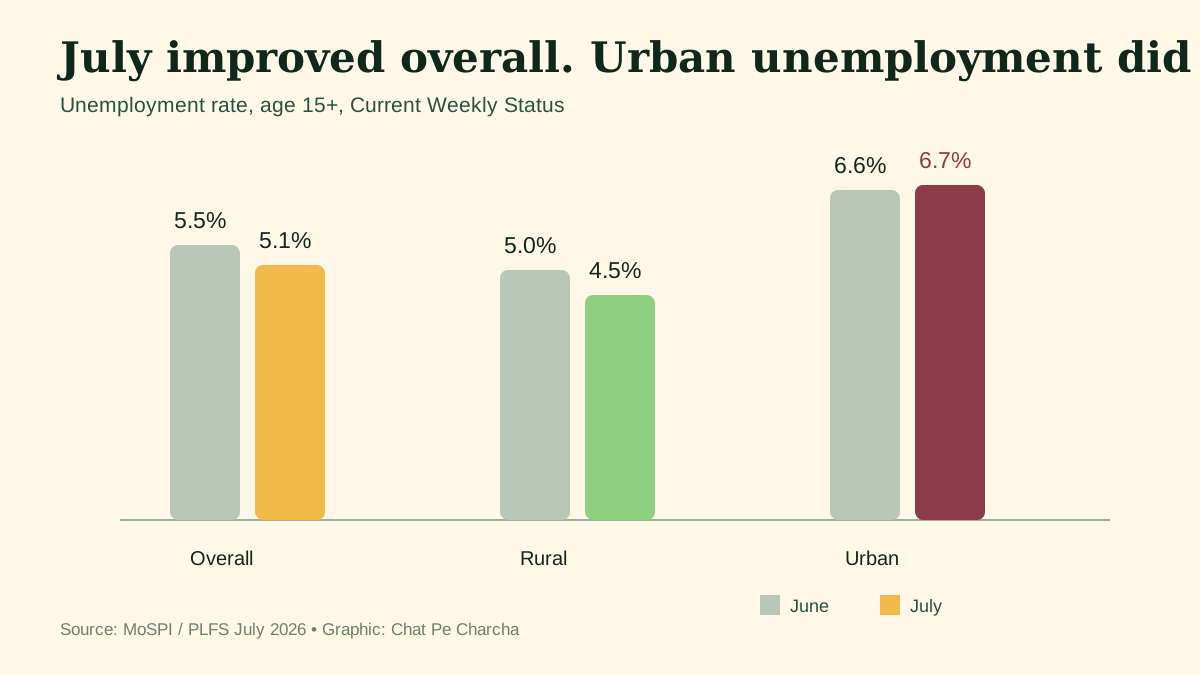
Overall and rural unemployment fell in July, while the urban rate moved slightly higher. Source: MoSPI, PLFS July 2026. Graphic: Chat Pe Charcha.
The year-on-year comparison is less gloomy for cities: urban unemployment was 7.2% in July 2025, compared with 6.7% in July 2026. So the urban rate is better than a year ago even though it worsened slightly from June.
This distinction matters. A single national percentage can improve even when one part of the labour market does not. Readers should resist treating 5.1% as evidence that every region or group experienced the same change.
More people joined the labour force
The labour force participation rate, or LFPR, rose to 55.4% in July from 54.4% in June. LFPR measures the share of the relevant population that is either working or actively looking for work.
The worker population ratio, or WPR, also improved, rising to 52.5% from 51.4%. WPR measures the share of the population that is actually employed.
Those movements are important because an unemployment rate can fall for different reasons. If people stop looking for work, they can leave the labour force and reduce the measured unemployment rate without gaining jobs. July's rise in both LFPR and WPR means the improvement cannot be explained simply by people disappearing from the labour force.
The female numbers need more than one headline
Female labour force participation rose to 34.4% from 32.7% in June. In rural India, female LFPR reached 38.8%, up from 36.6%.
But urban female unemployment rose to 8.8% from 8.4%. These numbers are not contradictory. More women can enter the labour force while a larger share of those women who are looking for work remain unemployed.
For readers, the useful question is therefore not merely whether female participation increased. It is whether women entering the labour market are finding stable, productive and adequately paid work. The headline PLFS indicators do not answer all of that.
What PLFS is actually measuring
The monthly PLFS bulletin uses the Current Weekly Status (CWS) approach. It classifies people's activity using their status during the seven days before the survey.
This matters when comparing today's monthly figures with older PLFS numbers. Annual PLFS publications also report measures based on usual status, which use a different reference period. A 5.1% monthly CWS unemployment rate should not be casually compared with an annual usual-status unemployment figure as if they were identical measurements.
MoSPI revised the PLFS design from January 2025 to make monthly and quarterly all-India labour-market estimates available. The July release is therefore part of a relatively newer monthly series.
Does 5.1% mean India's jobs problem is solved?
No. One monthly release cannot establish a structural trend, and unemployment alone does not measure job quality, wages, hours worked, underemployment or whether workers are in secure formal jobs.
The July data does show three concrete things: the overall unemployment rate fell, labour-force participation rose, and the worker population ratio rose. Those are meaningful improvements. It also shows that urban unemployment did not improve month-on-month and that urban female unemployment increased.
Reuters reported that the 5.1% headline was below the 5.4% median expectation in its poll. That gives the release some macroeconomic significance, but it still does not turn one month into a jobs boom.
What to watch next
The next useful test is persistence. If August and subsequent releases continue to show higher participation, a stronger worker population ratio and lower unemployment across both rural and urban India, the case for a broader labour-market improvement becomes stronger.
It will also matter whether urban female unemployment reverses, whether the urban-rural gap narrows, and what future quarterly and annual PLFS data says about employment type and quality.
CPC takeaway
July's labour data is better than June's at the national level, but the improvement is uneven. Rural India did most of the visible work in pulling the unemployment rate down, while cities remained stubborn. Female participation improved, but urban women looking for work faced a higher unemployment rate.
The responsible reading is neither celebration nor panic. It is simpler: India's July jobs numbers improved, but 5.1% is only the beginning of the story.
Sources and methodology
MoSPI / PIB: Periodic Labour Force Survey Monthly Bulletin, July 2026
MoSPI / PIB: Periodic Labour Force Survey Monthly Bulletin, June 2026
Reuters: India's jobless rate slips to four-month low of 5.1% in July
Editorial note: CPC uses the official PLFS release as the primary source and distinguishes Current Weekly Status from usual-status measures. The article does not infer job quality from the unemployment rate alone.