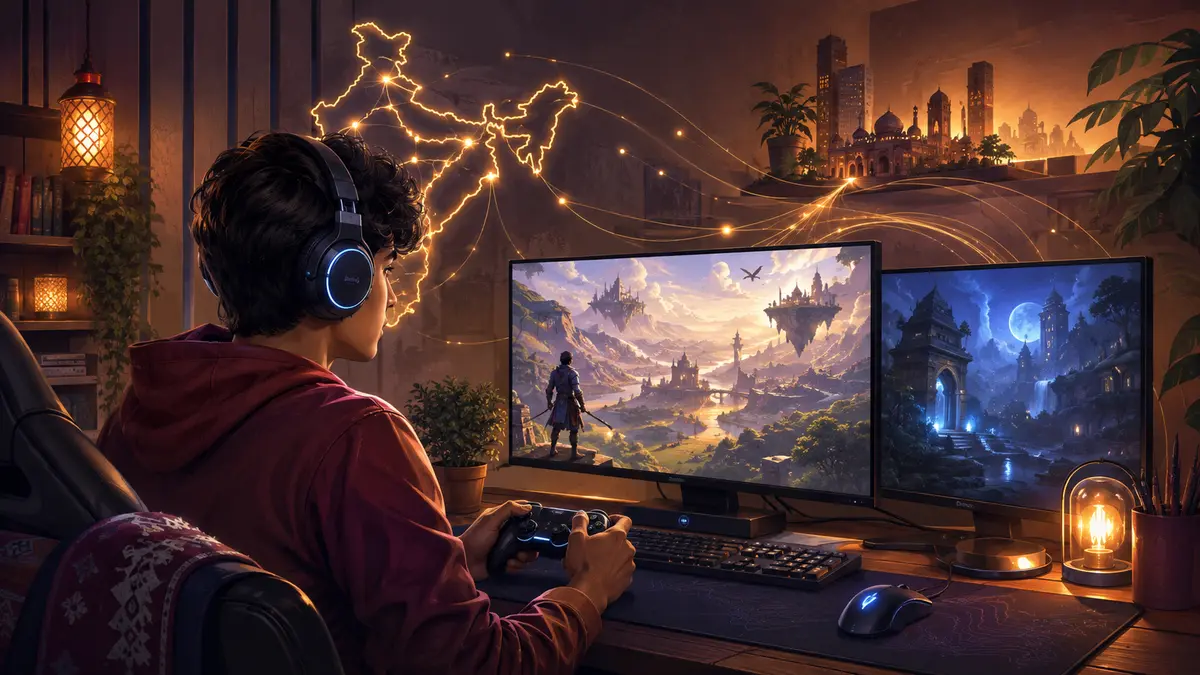

India has already proved it can produce a massive gaming audience. The next test is whether it can build enduring games, characters and studios of its own.
India already has the audience; the harder task is building the industry
Gaming in India is no longer a niche activity. Government and industry reporting place online gaming among the country's significant media and entertainment segments, while policy attention to animation, visual effects, gaming and comics has increased. The more interesting question now is not whether Indians play games. It is whether India can build more durable studios, original intellectual property and skilled production teams of its own.
A large player base creates demand, but demand alone does not create a strong domestic development ecosystem. If most of the games receiving attention are designed elsewhere, India remains an important market without capturing as much of the creative and technical value of making those games.
A large player base proves there is a market. Durable studios and original IP prove there is an industry.
Mobile was the opening level, not the final one
Affordable smartphones and data made gaming accessible to a huge number of people. Mobile remains central because it fits the devices and connectivity many Indian users already have. But the next stage of growth is not simply more downloads. It is better games, stronger monetisation that does not rely on harmful design, and studios capable of producing a second and third title after the first release.
That requires production knowledge that compounds over time: game design, engineering, art, testing, live operations, community management, publishing and player support. These jobs are less visible than a launch trailer, but they determine whether a studio survives long enough to learn from failure.
Original Indian games do not need to look stereotypically Indian
Local IP is often misunderstood as adding a famous monument, a festival event or a mythology skin to an otherwise generic game. The stronger opportunity is deeper. Indian creators can build from local storytelling rhythms, humour, neighbourhood competition, school life, sport, history or entirely invented worlds shaped by experiences familiar to them.
Government creative-economy briefings increasingly talk about indigenous IP and Indian studios creating games rooted in local narratives. The goal should not be to force every game to advertise its nationality. A game can feel authored in India without turning culture into decoration.
Skills infrastructure is finally getting policy attention
The Ministry of Information and Broadcasting has announced expansion of AVGC Content Creator Labs in schools and colleges, alongside broader efforts to develop the creative-technology talent pipeline. That is useful because game development is a multidisciplinary craft. A studio needs people who understand code, art, narrative, sound, production and business, not just players who love games.
Training alone will not solve studio economics, but it can widen the pool of people who see game development as a credible career. The next challenge is connecting that talent with internships, experienced mentors, publishers and companies that can provide real production experience.
The boring foundations matter most
Breakout hits make headlines. Sustainable industries depend on systems that are far less glamorous: project planning, quality assurance, version control, accessibility, customer support, data protection and clear career progression. A studio that cannot ship reliably will not become durable merely because the idea is exciting.
The same is true for funding. Games often require long development cycles and uncertain outcomes. Investors and publishers need to understand that a prototype can fail without the studio itself being worthless. Teams need enough runway to learn, but they also need discipline about scope so ambition does not become permanent delay.
Community can be an advantage, but it is not a substitute for the product
Indian gaming creators and esports communities can help studios reach players, collect feedback and build early attention. That distribution advantage is useful. It becomes dangerous when marketing activity outruns product quality.
A memorable launch cannot compensate for weak onboarding, unstable servers or repetitive design. Community works best when it forms around a game people genuinely want to return to, not when it is expected to manufacture retention through hype.
The real level-up is repeatability
India's gaming ecosystem will have matured when successful studios can do more than release one notable game. They should be able to retain experienced teams, improve their tools, build new IP and export creative work without starting from zero each time.
That is slower than celebrating download numbers, but it is a more useful measure of progress. India's next gaming chapter is not about proving that the country has players. That part is already obvious. It is about building the capability to create worlds those players, and players elsewhere, choose to stay in.