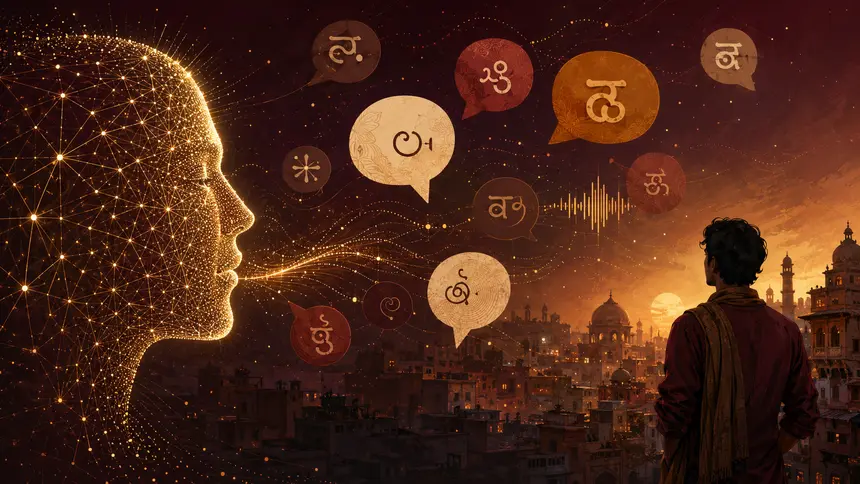

India’s AI opportunity is not simply translating global products. It is building systems that understand how people here actually speak, search, shop and think.
Language support is no longer the hard part
Indian-language AI has moved far beyond a translated menu or a Hindi keyboard. Government-backed BHASHINI now operates multilingual speech and text services at population scale, while IndiaAI hosts models built specifically for Indian-language tasks. That changes the product question. The challenge is no longer simply whether a system can produce Hindi words. It is whether the system understands what an Indian user actually means when language, context and local habits are mixed together.
That distinction matters because real conversations are messy. People code-switch between Hindi and English, use regional words inside otherwise Hindi sentences, shorten phrases, speak with local accents and rely on cultural references that make perfect sense to another person but may be ambiguous to a model. A technically correct translation can still be a poor answer if the system misses the intent behind the sentence.
India's language problem is also a context problem
BHASHINI's expansion is evidence that Indian-language technology is becoming serious infrastructure rather than a novelty. Government releases describe a growing ecosystem of speech recognition, translation, multilingual NLP and voice-first services used across public platforms. That is important, but it also reveals the next difficulty: domain context.
The language used by a shop owner discussing stock is different from the language used by a student asking about an exam or a citizen trying to understand a government service. The same Hindi word can carry different meaning depending on the industry, region and situation. A useful AI system therefore needs more than vocabulary. It needs domain-specific evaluation, representative examples and the ability to recognise uncertainty.
A model can translate a sentence correctly and still misunderstand the person who said it.
Code-switching should be treated as normal
Many Indian users do not stay inside one language at a time. A request can begin in Hindi, include an English product term and finish with a regional expression. Product teams sometimes treat that behaviour as noisy input that should be cleaned before processing. That is backwards. For many users, the mixed sentence is the natural sentence.
Designing for this reality means testing with actual conversational patterns rather than only clean textbook prompts. Voice systems must cope with background noise, informal pronunciation and incomplete thoughts. Text systems need to handle phonetic spellings and mixed scripts. The model should also be able to ask a clarifying question instead of confidently guessing when a phrase is ambiguous.
Local AI does not have to mean smaller ambition
Global foundation models will continue to improve at major Indian languages, and that is useful. The opportunity for Indian builders is not to recreate every global model from scratch. It is to build the layers that make those models dependable in Indian settings: better language data, domain-specific tools, voice interfaces, local evaluation and workflows designed around how people actually use technology here.
BHASHINI's recent work on multilingual and voice-first public services shows why this matters. In India, a product may need to work on an inexpensive phone, support voice before typing and remain useful when connectivity is inconsistent. Those constraints are not side notes. They shape the interface itself.
What good Indian-language AI should prove
A credible product should be tested on more than translation accuracy. Can it understand code-switching? Does it perform consistently across accents? Can it distinguish a literal request from a culturally familiar expression? Does it know when it is unsure? Can a user correct it easily? Does the answer remain useful on a small screen or through voice alone?
These questions are harder than adding another language option, but they are also where durable product advantage can emerge. Language is the doorway. Context, trust and reliability determine whether the user stays in the room.
The opportunity is lived understanding
India's multilingual AI infrastructure is getting stronger. That does not mean the problem is solved. It means the baseline is rising. The next generation of Indian AI products will be judged less by whether they can speak Hindi and more by whether they understand the situations in which Hindi, English and regional languages are actually used.
The products that feel genuinely local will not merely translate global software. They will be designed around Indian users from the beginning: their devices, their speech patterns, their constraints and their expectations. That is a much harder standard than translation, and a much more valuable one.